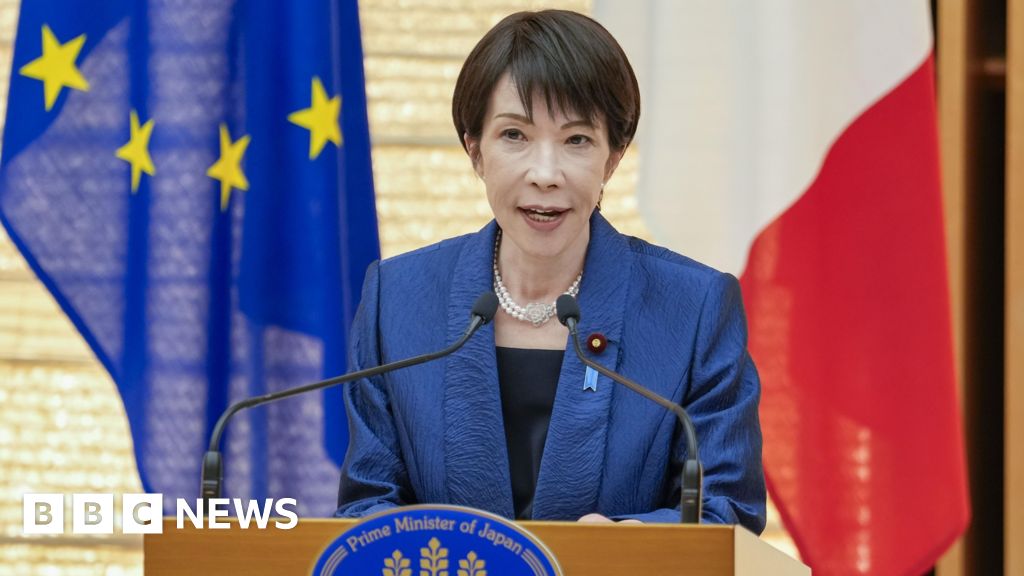
Japan’s Prime Minister Sanae Takaichi will dissolve parliament on Friday, paving the way for an early election on 8 February that she hopes will translate her strong public polling into a big majority in the lower house.
It was an “extremely weighty decision” that would “determine Japan’s course together with the people”, Takaichi told a news conference in Tokyo.
The country’s first female leader and her cabinet have enjoyed high public support since taking office last October.
But her party lags behind in polls and the move is risky. It’s Japan’s second general election in as many years and will test appetite for her plans to boost public spending when cost-of-living is top of voters’ minds.
Having been elected as prime minister by lawmakers on 21 October, Takaichi is now seeking a public mandate in the House of Representatives, the more powerful house in Japan.
Since the day she took office, Takaichi said, she has been “constantly concerned that the Takaichi cabinet has not yet been tested in an election where the public chooses the government”.
“Is Sanae Takaichi fit to be prime minister? I wanted to ask the sovereign people to decide,” she told the news conference.
Campaigning for the vote to elect the 465 lower house MPs, who serve four-year terms, starts on 27 January.
Her Liberal Democratic Party (LDP) has governed Japan almost continuously since 1955. It currently has 199 seats – including three held by its independent partners – in the House of Representatives, the most of any party. The LDP’s coalition with the Japan Innovation party gives it a fragile majority, with just enough seats to govern.
A protege of former conservative PM Shinzo Abe and self-professed admirer of Margaret Thatcher, Takaichi is known as Japan’s “Iron Lady”.
She came into office promising an economic upturn after years of stagnation.
Takaichi is an advocate of heavy government-led spending to drive economic growth – a revival of the sort of stimulus measures that Japan saw under “Abenomics”. Her first few months in office have seen soaring personal poll ratings – no Japanese PM has been popular since Abe, in 2012.
In December, her cabinet approved a record defence budget of nine trillion yen ($57bn; £43bn). This comes amid growing concern over China, with Tokyo describing its neighbour’s military activities in the region as its “greatest strategic challenge”.
Takaichi has found herself the target of China’s ire since last November, when she made comments suggesting that Japan could respond with its own self-defence force if China attacked Taiwan. The diplomatic spat that ensued has sent bilateral ties plunging to their lowest point in more than a decade.
Meanwhile, Takaichi has pursued closer ties with the US. During US President Donald Trump’s visit to Japan last October, the two leaders heaped praise on each other and signed a deal on rare earths. They also signed a document heralding a new “golden age” of US-Japan relations.
Opinion polls show that while the LDP remains broadly unpopular among Japanese residents, Takaichi and her government have charted approval ratings of 60-80%.
This popularity is what Takaichi hopes can help the LDP secure a “sole majority” in parliament and push through bolder policies more easily, Dr Seijiro Takeshita, a management professor at the University of Shizuoka, told the BBC World Service’s Asia Specific podcast.
“She wants to solidify her position to make things smoother at a later stage,” Takeshita said.
But the snap election gamble comes with its own set of risks.
The LDP’s leadership has been on shaky ground, and Takaichi is the country’s fourth PM in five years. Her predecessors’ terms were cut short by falling public support and scandals.
Her immediate predecessor, Shigeru Ishiba, also announced a snap election shortly after taking office – leading to one of the LDP’s worst ever results and costing the party its majority in the House of Representatives.
Another challenge looms in the form of a new, consolidated opposition, the Centrist Reform Alliance, which was formed last week by Japan’s largest opposition party, the Constitutional Democratic Party of Japan, and the Komeito party, the LDP’s former coalition partner.
Takaichi said the dissolution of parliament was being carried out only “after establishing a thorough system” which ensures there is no disruption to economic policies affecting livelihoods and rising prices.
What Takaichi is hoping for is that “people will trust her to deliver on her promises”, Dr Jeffrey Kingston, an Asian studies professor at Temple University in the US, told the BBC.
Her high approval ratings are “only going to decline so she wants to lock in the benefits of a long honeymoon”, he added.
https://ichef.bbci.co.uk/news/1024/branded_news/caa6/live/5f412320-f4f3-11f0-a8b5-f36065d0e7ae.jpg
2026-01-19 12:00:48